
The Race to Reinvent Drug Development — and the AI Tools Making It Possible
Introduction
Bringing a new drug to market has traditionally taken 10 to 15 years and cost upwards of $2 billion.
The process is gruelling, expensive, and riddled with failure. Nine out of ten drug candidates never make it past clinical trials.
Artificial intelligence is rewriting that equation — and the impact is already being felt across the industry.
The Old Way vs. The New Way
Traditional drug discovery relied on trial and error — scientists screening thousands of compounds, one by one, hoping to find a molecule that binds to the right target without causing harm.
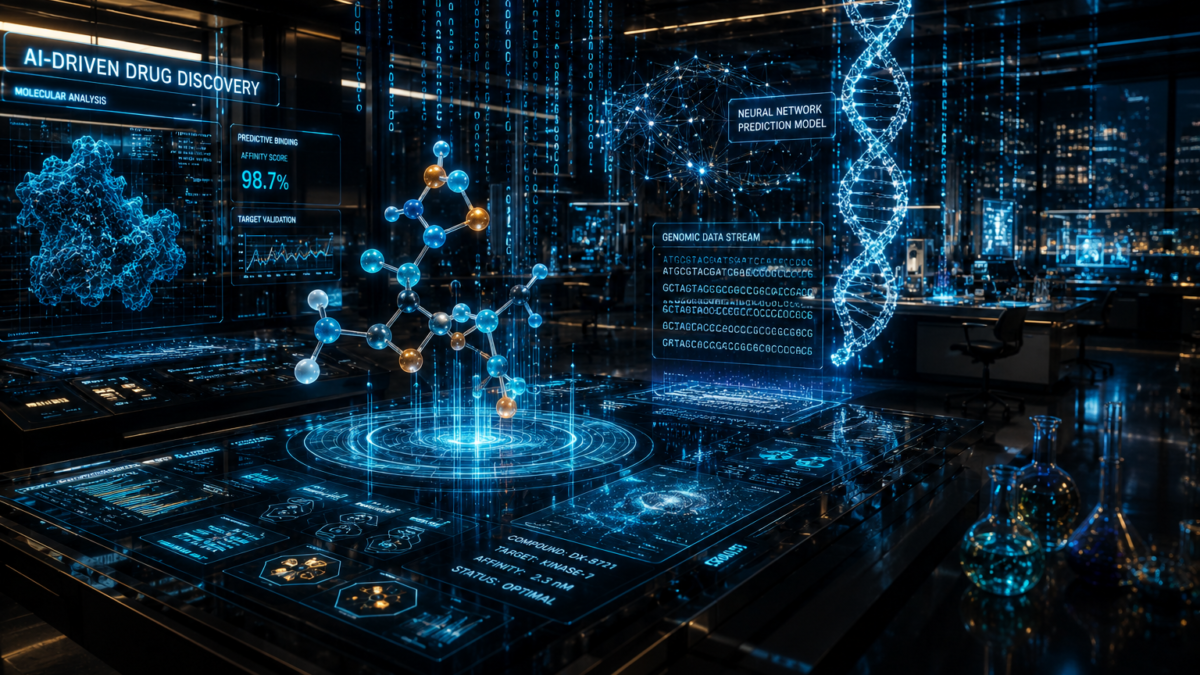
AI changes the starting point entirely. Machine learning models can screen billions of molecular combinations virtually, predict binding affinity, flag toxicity risks, and prioritise the most promising candidates — before a single experiment is run in the lab.
What once took five years in the target identification and lead optimisation phases can now be compressed into months.
Where AI Is Making the Biggest Impact
Target identification is faster. AI models trained on genomic, proteomic, and clinical datasets can surface novel biological targets that human researchers might take years to find.
Molecular design is smarter. Generative AI tools — building on breakthroughs like AlphaFold — can design entirely new drug molecules optimised for potency, selectivity, and safety from scratch.
Clinical trial design is leaner. AI-powered patient stratification, adaptive trial designs, and dropout prediction are reducing the cost and duration of Phase 2 and Phase 3 studies dramatically.
Companies like Recursion Pharmaceuticals, Insilico Medicine, and Isomorphic Labs are already running AI-native drug discovery pipelines — and advancing candidates into human trials at timelines that would have seemed impossible five years ago.
The Challenges That Remain
AI in drug discovery is powerful — but not infallible. Models are only as good as the data they are trained on. Bias in datasets leads to blind spots in discovery. And the translation from computational prediction to clinical reality remains the industry’s hardest problem.
Regulatory frameworks are also catching up. The FDA and EMA are actively developing guidance for AI-assisted drug development — but the field is evolving faster than policy.
Conclusion
AI is not replacing drug discovery. It is radically accelerating it — shifting the question from “can we find a drug?” to “how fast can we get it to patients?”
For life science organisations that embrace AI-native workflows now, the competitive advantage will compound with every passing year.
At Life Science Insights 360, we track the innovations reshaping the future of medicine. Follow us for more.
Want to stay ahead of the AI revolution in drug discovery?
Follow Life Science Insights 360 for weekly insights.
#ArtificialIntelligence #DrugDiscovery #Biopharma #Biotech #LifeSciences #MachineLearning #ClinicalTrials #HealthcareInnovation #AIinHealth #Pharma #DrugDevelopment #PrecisionMedicine #DigitalHealth